
Understand Your Label
Every SHENI Paris bottle carries its own proof. The back label is not decoration — each element on it opens a door to the documentation behind your exact bottle. Here is how to read it, in simple language.
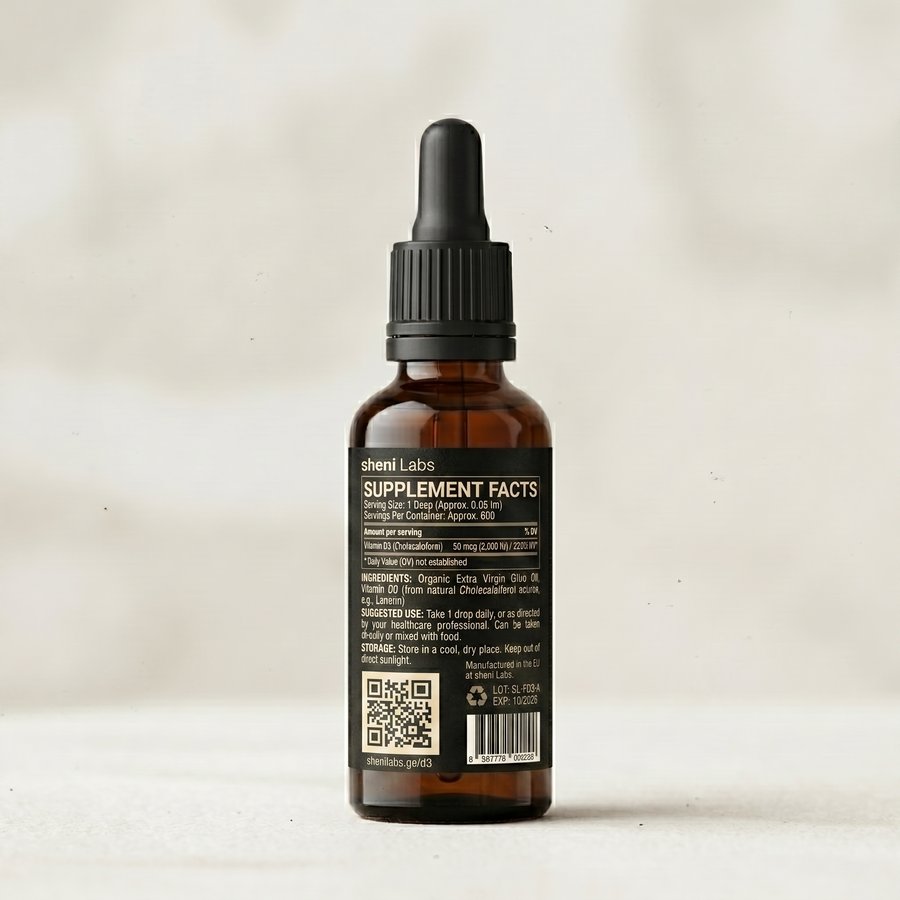
The numbers correspond to the guide below.
What each element means
Plain language, no jargon — the same label logic used in pharmaceutical packaging. Every statement carries its source: that is part of our DNA.
Production standards: the Sheni Labs line is manufactured under vegan, gluten-free, cruelty-free, not-tested-on-animals production standards — declared in the manufacturer’s signed Statement of Standards and confirmed in writing (declarations held on file; copies on request). What a declaration is worth — GMJ News.
Why this matters
Food supplements are regulated as foods, not medicines. In the EU and most countries there is no pre-market approval: no authority tests a supplement before it reaches the shelf.[1] Responsibility for what is inside the bottle rests entirely with the producer — and independent market studies repeatedly find products with much less active ingredient than declared, substitutions, or contamination.[2] The WHO warns that substandard and falsified products routinely enter legitimate supply chains worldwide.[3]
In this world, a readable, checkable label is your main protection as a buyer. Knowing where the LOT number is, what the QR code opens, and what a Certificate of Analysis proves is not technical knowledge — it is basic health literacy, like reading a nutrition panel.
What to do — with any supplement, not only ours:
- Look for a LOT / batch number and expiry date. No batch number means no traceability — and no recall if something is wrong.[4]
- Check whether the producer offers batch-level verification and published laboratory documents. A brand that tests every batch will show you the paperwork.
- Read the ingredients line, not the front of the pack. The front is marketing; the back is regulated information.[5]
- Check the packaging against the ingredient: light-sensitive actives in clear bottles, or daily oils in plastic, are quality warnings in themselves (see below).
- If a product fails these checks, ask the seller for the Certificate of Analysis. The reaction tells you everything.[6]
Why amber glass — and the microplastics question
The bottle itself is part of the quality system, chosen for two documented reasons:
1. Light protection. Amber UV-filtering glass lets through less than 10% of light below 450 nm — the range in which vitamin D3 and other fat-soluble actives break down. Clear packaging gives no real protection; amber glass is the pharmacopoeial standard for light-sensitive oral liquids.[7]
2. Inertness — the microplastics and heavy-exposure question. Glass is chemically inert: it sheds nothing into the product, and nothing migrates from it. Plastic is different. A widely cited analysis of 259 bottled waters found microplastic particles in 93% of samples,[8] and research shows plastic packaging can release micro- and nanoplastics into its contents — with fatty, oil-based liquids of particular concern for migration, which is exactly why EU food-contact law sets strict migration limits for plastics.[9] Health effects of long-term microplastic intake are still being studied;[10] our position is simpler: for a daily oil taken over years, we remove the question entirely by using glass (full explainer — GMJ News). The only plastic part — the dropper — carries its own food-contact compliance documents (see the packaging stage of the documentation chain). Heavy metals are handled the same way: not assumed safe, but measured — every batch is tested by ICP-MS against strict international limits.[11]
All certificates & testing, product by product
Everything described on this page is documented. Each product has its own page with the full nine-stage documentation chain — facility certificates, every test with its plain-language “why”, packaging declarations, transport, Georgian state registration, and storage.
Omega-3EPA/DHA · algae oilSpecification published
Vitamin Ed-alpha-tocopherolSpecification published
AstaxanthinH. pluvialis · natural esterSpecification published
CoQ10Ubiquinol · reduced formSpecification published
Vitamin K2All-trans MK-7Specification published
Vitamin B12MethylcobalaminSpecification published
Vitamin ARetinyl palmitateSpecification published
References
- Directive 2002/46/EC on food supplements; Regulation (EC) 178/2002 (general food law). Explainer — GMJ News.
- Crawford C et al. Analysis of select dietary supplement products marketed to support or boost the immune system. JAMA Netw Open. 2022;5(8):e2226040. Explainer — GMJ News.
- WHO. A study on the public health and socioeconomic impact of substandard and falsified medical products. Geneva: WHO; 2017.
- Regulation (EC) 178/2002, Art. 18 (traceability). Explainer — GMJ News.
- Regulation (EU) 1169/2011 (food information to consumers).
- How to read a supplement Certificate of Analysis. GMJ News.
- Ph.Eur. 3.2.1 (glass containers for pharmaceutical use); Why B12 needs amber glass: cobalamin photodegradation. GMJ News.
- Mason SA, Welch VG, Neratko J. Synthetic polymer contamination in bottled water. Front Chem. 2018;6:407. Explainer — GMJ News.
- Regulation (EC) 1935/2004; Regulation (EU) 10/2011 (plastic food-contact materials).
- WHO. Microplastics in drinking-water. Geneva: WHO; 2019.
- ICH Q3D (R2): Guideline for elemental impurities — permitted daily exposures, oral route.
Anonymous. No account, no email — just your bottle.