
Last updated: August 20, 2026
Product Specification
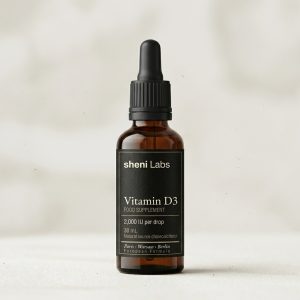
What form of vitamin D is in Sheni Labs Vitamin D3? Cholecalciferol (vitamin D3), the same form the body produces naturally from sunlight exposure.[1]
What is the dose per drop? 50 micrograms (2,000 IU) of cholecalciferol per drop.
What is the NRV percentage? 1,000% of the EU Nutrient Reference Value. The EU NRV for vitamin D is 5 micrograms (200 IU);[2] this product delivers 50 micrograms (2,000 IU) per drop.
What is the bottle size? 30 mL, approximately 800 servings (drops).
Where is it manufactured? European Union, under GMP, ISO 22000:2018, and HACCP certification.
What is the carrier oil? MCT oil (Miglyol® 812 N, Ph.Eur. grade, Kosher and Halal certified).
Vitamin D3 vs D2
Why D3 instead of D2? A systematic review and meta-analysis of 10 randomised controlled trials found that vitamin D3 supplementation raised serum 25-hydroxyvitamin D levels significantly more effectively than vitamin D2 at equivalent doses.[3] D2 (ergocalciferol) is the form more commonly used in food fortification and some lower-cost supplements.
Is the difference clinically meaningful? Yes. The same meta-analysis found the advantage of D3 over D2 was greatest at higher doses and with daily (versus bolus) dosing schedules — the delivery format used by Sheni Labs.[3]
How It Works
How does the body use vitamin D3? Cholecalciferol is absorbed into the bloodstream and converted first in the liver (to 25-hydroxyvitamin D3, the form measured in blood tests) and then in the kidneys (to 1,25-dihydroxyvitamin D3, the active hormonal form).[4] This two-step conversion means that individuals with liver or kidney impairment may need medical advice on vitamin D dosing.
Usage
Recommended use? Adults: 1 drop daily, with or without food, unless otherwise advised by a healthcare professional. Fat-soluble vitamins including D3 absorb better when taken with a meal containing fat, though the small MCT oil carrier in each drop provides some lipid context regardless.
How do I know if I need vitamin D? A blood test measuring 25-hydroxyvitamin D (25(OH)D) is the standard way to assess vitamin D status. What to ask for and how to read your result — GMJ News
Is this suitable for children? Keep out of reach of young children. Consult a healthcare professional before giving to children — children have different dose requirements per body weight.
Safety
What is the tolerable upper intake level? EFSA has set the tolerable upper intake level (UL) for vitamin D in adults at 100 micrograms (4,000 IU) per day.[5] This product delivers 50 micrograms (2,000 IU) per drop — 50% of the adult UL with one serving. Do not take more than the recommended dose without medical guidance.
Verification
How do I verify my bottle is authentic? Enter the LOT number printed on the bottle at shenilabs.ge/verify-your-batch/ to see manufacturing date, expiry, country of origin, and available Certificate of Analysis documentation for that specific batch.
References
- Vitamin D: who is at risk and how to know — GMJ News. Primary source: Holick MF. Vitamin D deficiency. N Engl J Med. 2007;357(3):266–281. doi:10.1056/NEJMra070553.
- What 1,000% on a label really means: the EU NRV system — GMJ News. Primary legislation: Regulation (EU) No 1169/2011, Annex XIII: Nutrient Reference Values for labelling. Vitamin D NRV = 5 µg (200 IU).
- Vitamin D3 vs D2: the full evidence — GMJ News. Background: earlier news report. GMJ News. Primary study: target=”_blank” rel=”noopener”>Vitamin D2 supplements may lower D3 levels — GMJ News. Primary study: Tripkovic L et al. Comparison of vitamin D2 and vitamin D3 supplementation in raising serum 25-hydroxyvitamin D status: a systematic review and meta-analysis. Am J Clin Nutr. 2012;95(6):1357–1364. doi:10.3945/ajcn.111.031070.
- How Vitamin D Becomes Active: The Three-Organ Pathway Explained. GMJ News, 2026.
- What EFSA health claims mean for supplements — GMJ News. Primary document: EFSA Panel on Dietetic Products, Nutrition and Allergies (NDA). Scientific Opinion on the Tolerable Upper Intake Level of vitamin D. EFSA Journal. 2012;10(7):2813. doi:10.2903/j.efsa.2012.2813. Adult UL = 100 µg (4,000 IU)/day.
Further Reading
Evidence on Vitamin D3 · Evidence Hub (all citations) · Independent ingredient database · Full product page
The product
SHENI Paris Vitamin D3 — formulated and documented by Sheni Labs; sold at sheni.fr. By its own rule the lab does not grade its own products: the certificate of analysis for each batch and the lot-number check are published here so you can judge. Verify a batch →